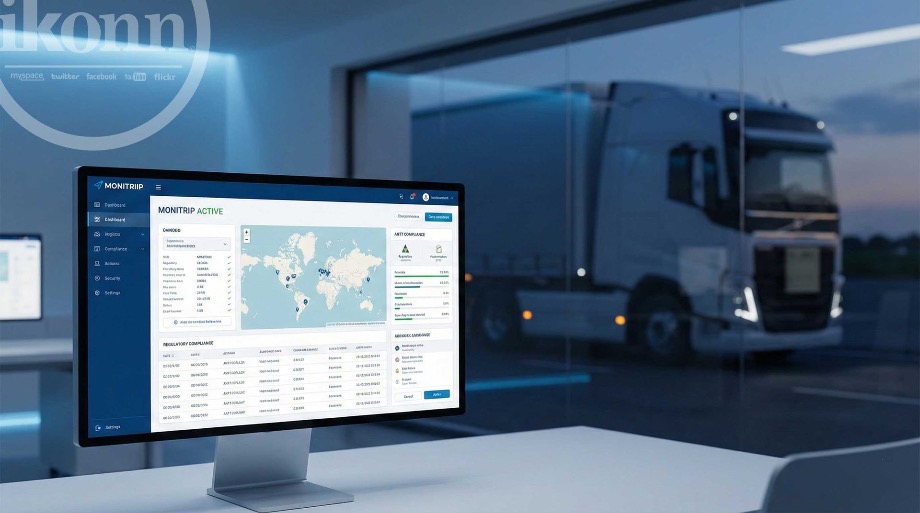
Regulatory Engineering: The Definitive Guide ANTT
The convergence between legal obligation and data accuracy in road transport.
The New Era of Digital Auditing
In the contemporary Brazilian transportation landscape, compliance with the regulations of the National Land Transport Agency (ANTT) has ceased to be a mere bureaucratic task and has become a critical challenge in software engineering and network infrastructure. The digitalization of inspection processes demands that carriers and tracking centers operate with absolute precision in data collection and transmission. This comprehensive guide details how the Ikonn platform uses advanced telemetry to guarantee legal sovereignty in relation to Resolution 4.499, Monitriip, and the complex Driver Law.
1. The Monitriip Architecture and Resolution 4.499
Monitriip (Interstate and International Road Passenger Transport Monitoring System) is the regulatory heart of passenger transport. Established by Resolution No. 4,499, the system requires each vehicle to transmit constant data to ANTT servers. At Ikonn, we don't treat Monitriip as a simple "black box," but as an intelligent data flow subdivided into four essential layers.
The first layer is Geographic Positioning . Using multi-GNSS technology, we ensure that the vehicle is located even in adverse weather conditions or in urban canyons. The transmission frequency is dictated by the standard, but Ikonn adds a Smart Buffer layer: if the GPRS/4G signal fails in remote regions, the hardware stores each position log with its original timestamp and resends it en masse as soon as connectivity is restored, avoiding "holes" in the fiscal history.
The second and third layers involve Electronic Ticketing and Driver Identification . Native integration allows each issued ticket to be linked to the exact boarding location, sending an inviolable record to the ANTT (National Agency for Land Transport). Identification via RFID or iButton ensures that the driver is properly licensed and fulfilling their work schedule, eliminating common fraud in manual logbook systems.
2. Law 13.103/15: The Technical Control of Working Hours
The Driver's Law (Law 13.103) brought unprecedented responsibility to fleet managers. Monitoring working hours is not just about clocking in and out, but about the physical safety of the driver and the cargo. Our engineering transforms ignition and motion sensors into real-time auditors.
The software automatically monitors the legal limit of 5.5 hours of uninterrupted driving . Through predictive algorithms, the system sends alerts to both the central control and the driver's cabin terminal when the driver reaches 5 hours behind the wheel. This 30-minute interval is the safety margin for the driver to locate a safe and appropriate stopping point, avoiding fines and points on their driver's license. Furthermore, the monitoring of the 11-hour rest period between shifts and the meal break is validated by the accelerometer: any improper vehicle movement during the rest period generates a "Rest Violation" event, protecting the company against labor lawsuits for excessive working hours.
3. Cargo Registration and MDF-e Integration
For freight transport (TRC), ANTT focuses on the validity of transport via the Electronic Manifest of Tax Documents (MDF-e) . One of the biggest financial risks for a transport company is operating with cargo without proper registration with the insurance company. Ikonn telemetry integrates with ERP systems (such as Odoo) to perform Automated Registration .
As soon as the vehicle starts moving, the system cross-references the tracker data with the issued MDF-e (Electronic Manifest of Freight Documents). If the tracking destination or the planned route differs from what was registered, or if the registration process was not completed, the control tower receives a critical alert. This "Risk Engineering" ensures that, in the event of a claim, the insurance company cannot deny payment due to lack of documentation or unauthorized route deviation.
4. Precision Telemetry via CAN Bus (J1939)
A blind spot in many market solutions is the inaccuracy of the odometer calculated solely via GPS. For ANTT (Brazilian National Agency for Land Transport) and tax audits, the mileage must be exact. Ikonn uses direct reading from the CAN bus (J1939 protocol) . By accessing the vehicle's ECU (Electronic Control Unit), we extract the actual factory odometer and hour meter readings.
This precision is vital for rigorous preventive maintenance plans and for proving compliance in road inspections. If the ANTT (National Agency for Land Transport) questions the mileage traveled between two points, the data extracted from the CAN (National Autonomous Vehicle) has superior probative value, as it reflects the mechanical operation of the vehicle, independent of satellite signal interference that may occur in tunnels or underground areas.
5. Cybersecurity and Fiscal Data Integrity
Data integrity is the foundation of technological sovereignty. If a position log can be altered, it loses its legal validity. Our infrastructure uses AES-256 encryption and an immutable database architecture for regulatory records.
During an inspection by the ANTT (National Agency for Land Transport), the tracking center may be asked to prove that there was no data manipulation. Ikonn provides audit trails that show each system interaction, ensuring that the data received from the hardware is exactly the same as what was reported to government agencies. Cybersecurity, therefore, is not only about preventing hackers, but also about shielding the company against suspicions of tax fraud.
6. Technical Conclusion and Operational Sovereignty
Regulatory compliance with the ANTT (Brazilian National Agency for Land Transport) should not be seen as an obstacle, but as the minimum standard of excellence for those who wish to operate in the high-value market. Using an engineering platform like Ikonn allows the carrier to transcend mere "legal obligation" and use this data to optimize costs, reduce claims, and ensure complete legal security.
When the law demands control, cutting-edge technology provides intelligence. Compliance is, above all, a demonstration of respect for the asset, the driver, and the end customer. It proves that the operation is managed by data, not assumptions, ensuring the long-term sustainability of the business in an increasingly rigorous and digitalized regulatory environment.