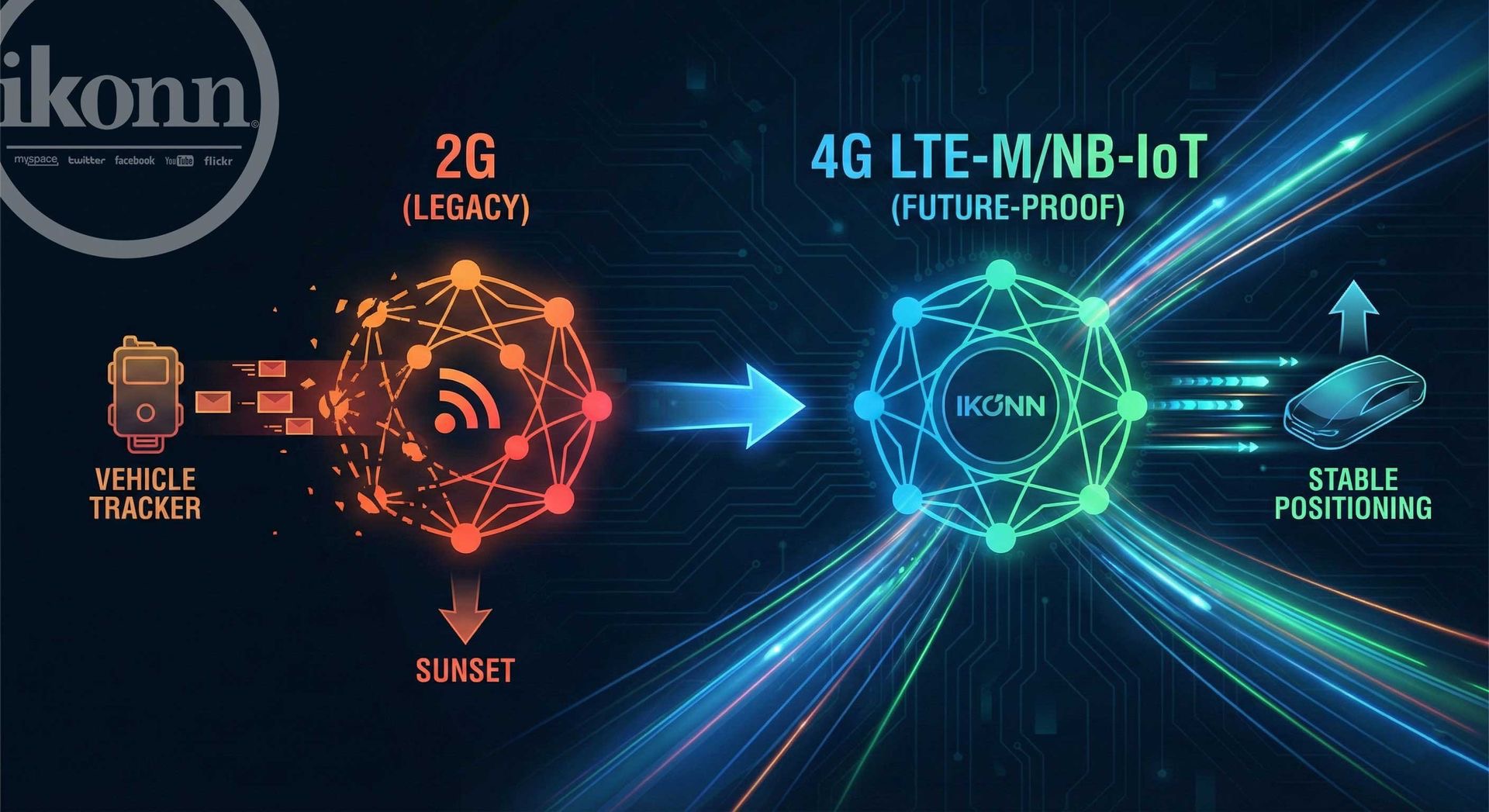
2G vs 4G Tracking: The end of legacy networks and the impact on positioning.
The global telecommunications infrastructure is abandoning legacy frequencies. Understand why migrating to 4G is a vital step to keep your fleet connected and resilient.
The Sunset of 2G and 3G Networks: The Challenge of Obsolescence
In the telecommunications industry, the term "Sunset" refers to the planned shutdown of older technologies to make way for more efficient networks. For the vehicle tracking sector, the end of 2G and 3G networks represents a technical watershed moment. Maintaining an infrastructure based on decades-old protocols is a strategic risk that compromises the technical autonomy of the control center. Since you value the impeccable maintenance of each asset, understanding that 2G is becoming an artificial "shadow zone" is essential for the governance of your fleet.
With operators shutting down 2G towers to reallocate frequencies to 4G and 5G (refarming), older trackers are beginning to experience intermittent connection failures, even in areas with theoretical coverage. This instability scenario generates reactive support costs that could be eliminated with a planned migration to modern IoT technologies, such as LTE-M and NB-IoT.
4G LTE-M and NB-IoT: Low-Power Engineering
Unlike the high-speed 4G of smartphones, cutting-edge vehicle tracking utilizes specific categories known as Cat-M1 (LTE-M) and NB-IoT . These technologies were designed for the "Internet of Things," offering superior signal penetration in indoor environments (basements and garages) and drastically reduced energy consumption.
By migrating to 4G, the central system gains not only in stability but also in latency. The digital "handshake" of 4G is milliseconds faster than that of 2G, meaning that critical alerts and commands sent via the Ikonn platform are executed with much greater temporal precision. This agility is what sustains the rules engine in real-time decision-making, ensuring that the digital footprint is a faithful copy of physical reality.
Direct Impact on Positioning and AGPS
One often overlooked point is how the cellular network affects GPS speed. Modern 4G modules have greater processing capacity to handle AGPS (Assisted GPS) . Through the 4G network, the tracker downloads orbital data from the satellites (Ephemeris) almost instantaneously, reducing the time to fix position (TTFF) from minutes to a few seconds.
In a congested 2G network, downloading this data can fail, forcing the hardware to perform a lengthy "Cold Start." Therefore, migrating to 4G not only improves communication (GPRS) but also accelerates location intelligence (GPS). Keeping the hardware in "new condition" means ensuring it utilizes the fastest available data highways, eliminating the informational "bottlenecks" of legacy networks.
Security and Cryptography in the New Era
Information security is another pillar that justifies the transition. 2G networks are inherently more vulnerable to interception attacks and tower spoofing (IMSI-catchers). 4G introduces military-grade encryption layers in the authentication between the device and the cellular network, ensuring that your company's telemetry data travels in a secure and auditable environment.
Ikonn University focuses on preparing control centers for this new reality, where automation and data security go hand in hand. By adopting 4G trackers, your control center is not just switching networks; it is raising the standard of protection for monitored assets, shielding operations against past technical vulnerabilities.
Conclusion: Leadership Through Modernization
The end of 2G networks is a golden opportunity for monitoring centers seeking market leadership. By anticipating the migration to 4G, your company eliminates the risk of abrupt interruptions and offers customers superior technology in precision, speed, and coverage. At Ikonn, we provide the necessary infrastructure for this transition to occur smoothly, ensuring your fleet remains visible, secure, and technologically impeccable.
IKONN SUPPORT: Engineering the future for those who govern the present.
Is your fleet prepared for the end of 2G networks?
Consult our engineering team to plan your migration to 4G LTE-M and ensure your tracking infrastructure operates with maximum performance and technological longevity.