Electromagnetic Interference: How Installation Affects the GPS Antenna
The accuracy of digital tracking depends on a clean electromagnetic environment. Understand how electronic noise and installation faults degrade the GNSS signal and compromise fleet safety.
The Fragile Nature of Satellite Signals
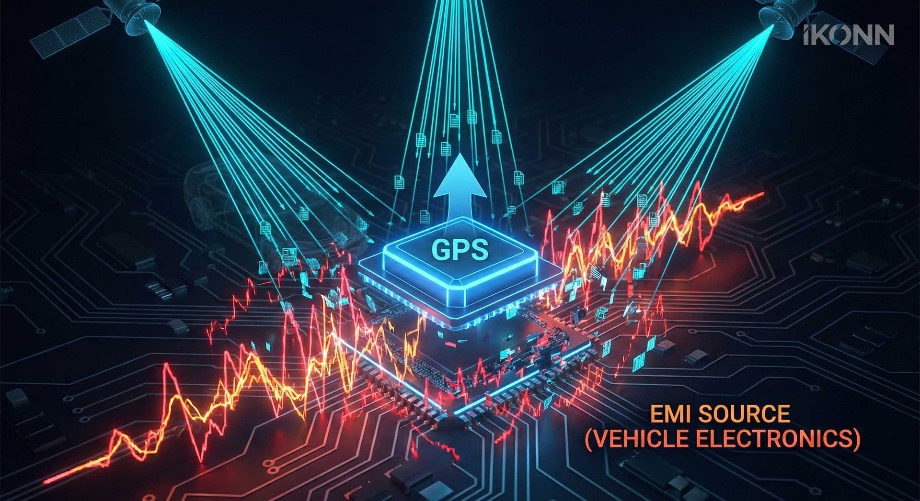
The GPS signal reaching the vehicle is, by nature, extremely weak. Emitted by satellites thousands of kilometers away, it reaches the antenna with less power than the Earth's thermal background noise. For a monitoring operation that requires "fresh" data to be processed, any source of Electromagnetic Interference (EMI) within the vehicle can be fatal to trilateration accuracy. When the electromagnetic environment is saturated, the GPS receiver has difficulty distinguishing the useful signal from the noise, resulting in position errors or total signal loss.
Ensuring the integrity of this signal requires installation engineering that respects the laws of physics. At Ikonn, we understand that technological infrastructure is only fully effective when protected against interference generated by the vehicle's own electronic components, such as alternators, ignition systems, and internal communication modules.
Noise Sources and the SNR (Signal-to-Noise Ratio)
The health of a GPS antenna is measured by its SNR (Signal-to-Noise Ratio) , expressed in dBHz. In a flawless installation, we expect values above 35-40 dBHz for the main satellites. However, sources of interference such as low-quality DC-DC converters, poorly insulated wiring harnesses, and even other nearby radio devices can raise the "noise floor," dropping the SNR to levels where the position becomes unstable.
This electromagnetic noise can come in two forms: conducted (through power cables) or radiated (through the air). The rigor in the choice of materials and cable routing is what differentiates a professional installation from an improvised one. Automated diagnostics on the Ikonn platform allow for the identification of sudden SNR drops, alerting the plant to potential sources of interference or insulation faults in the hardware.
Good Installation Practices: Isolation and Positioning
To mitigate the effects of EMI, the golden rule is distance. The GPS antenna should be installed as far away as possible from noise-generating sources and other antennas (such as FM/AM or UHF radio antennas). Furthermore, the use of shielded cables and proper grounding of the equipment are fundamental to prevent the tracker's wiring harness from acting as a receiver antenna for unwanted noise.
Another critical point is physical obstruction. Metallic elements near the antenna not only block the signal (Shadow Effect), but can also reflect signals, causing the multipath phenomenon, which confuses the GNSS module's calculations. Keeping the antenna with an unobstructed view of the sky, preferably under non-metallic surfaces such as the plastic panel, is essential to ensure the fluidity of the digital trail.
The Role of the Rules Mechanism in EMI Detection
Ikonn's intelligence goes beyond simply displaying position; our Rules Engine analyzes the quality of the received data. Through algorithms that monitor the fix mode status and HDOP (Horizontal Dilution of Precision) variation, we can identify when a vehicle is experiencing constant interference. If a tracker reports 10 satellites but with degraded precision, the system identifies a likely electromagnetic conflict.
This proactive approach allows the control center to perform preventative maintenance, adjusting the installation before a real security failure occurs. It's automation technology working to ensure the technical autonomy of your operation, keeping the fleet always visible and with high-fidelity data.
Conclusion: Engineering at the Service of Safety
Electromagnetic interference is an invisible challenge, but its impacts on vehicle tracking are tangible and dangerous. By applying rigorous technical standards to the installation and using Ikonn's advanced diagnostic tools, your control center ensures that the GPS signal remains clean and accurate. Operational excellence stems from controlling these physical details, transforming the complexity of radio frequency into real security for your client.
IKONN SUPPORT: Mastering the physics of data for total control of your fleet.
Is your control center technically prepared to eliminate interference?
Consult our support and engineering team to audit the signal quality of your fleet and ensure your tracking infrastructure operates at peak efficiency.