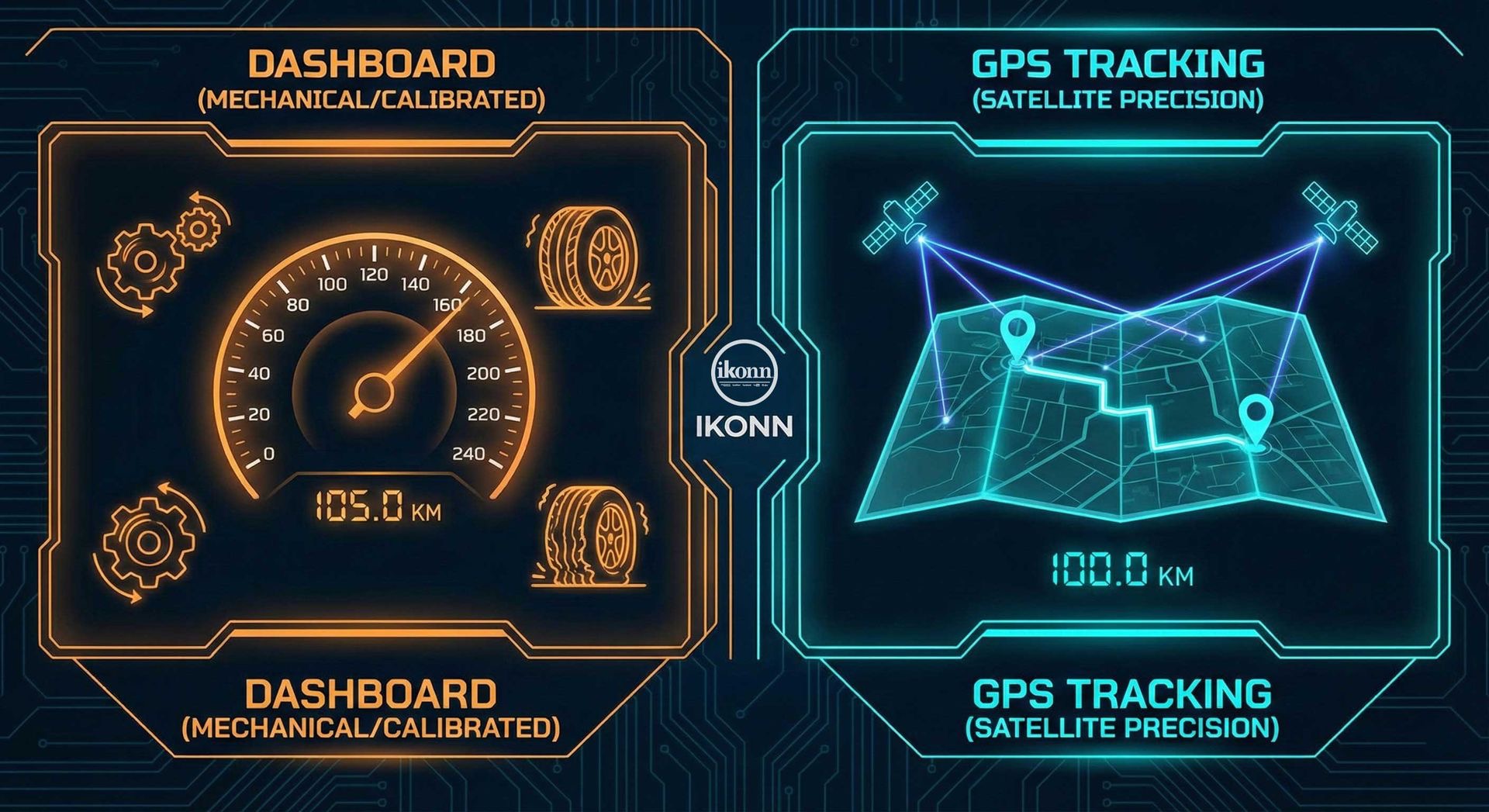
Odometer Errors: Why does the GPS distance differ from the dashboard reading?
Metric truth vs. factory calibration. Understand the physical and mathematical reasons behind mileage variation and how to ensure absolute accuracy.
The Conflict of Two Truths
One of the most frequent questions we receive in technical support is the discrepancy between the odometer reading displayed on the tracking platform and the value shown on the vehicle's physical dashboard. For clients who manage fleets rigorously, this variation of 3% to 7% may seem like a system error. However, at Ikonn, we treat this discrepancy not as a fault, but as the result of the mathematical superiority of GPS over vehicle mechanics. Understanding that GPS measures the actual displacement on the globe , while the dashboard measures the rotation of the axle , is the first step towards technical autonomy.
1. Tire Geometry: The Cumulative Error
The odometer on the dashboard is a revolution counter calibrated for a specific tire circumference. However, tires are not rigid objects. Factors such as inflation pressure (a deflated tire has a smaller radius), tread wear (new vs. bald tires), and even thermal expansion at high speeds alter the dynamic radius of the wheel.
A difference of just 5mm in tire radius can result in a cumulative error of several kilometers at the end of a long trip. While the dashboard "thinks" it has traveled a distance based on rotations, the Ikonn GPS ignores these mechanical variations, calculating the actual distance traveled point by point, regardless of tire condition.
2. The "Safety Margin" of Car Manufacturers
It's an automotive industry standard (standards like SAE J1226) that speedometers and odometers never show lower readings. For legal and safety reasons, automakers calibrate the dashboards to display speed and distance slightly higher than the actual speed (usually between 5% and 10%).
This prevents drivers from being fined for speeding due to a reading error, but it creates an illusion of distance traveled that does not reflect the actual geographical location. GPS, free from these regulatory obligations, delivers the "raw" data, which often creates the feeling that the tracker is underreporting, when in fact it is the only one measuring the correct distance.
3. Sampling and Path Curvature
This is where the importance of the Angle Change and Time Interval settings we discussed earlier comes in. If a tracker is set with very long time intervals, it "cuts off" the curves, calculating the hypotenuse instead of the arc of the curve. This reduces the total mileage.
At Ikonn, our data engineering utilizes interpolation algorithms and high angle update rates to ensure the digital track is a faithful copy of the path traveled. When configured correctly, the Ikonn GPS odometer achieves 99.5% accuracy, surpassing any mechanical wheel sensor.
How to Resolve Technical Disputes
For modern vehicles, we support integration via CAN Bus , which reads the vehicle's original onboard computer odometer. This way, you offer the customer a choice: the absolute precision of GPS or the convenience of reading the odometer on the dashboard. This autonomy of choice is what keeps your operation at its peak, transforming a complaint into a technology lesson for your customer.
Conclusion: Science in favor of Management
Odometer discrepancies are not malfunctions; they are evidence of the accuracy of satellite monitoring. By educating your client about tire physics and manufacturer calibration, you elevate your support from "problem solver" to "engineering consultant." At Ikonn, we work to ensure your data is unquestionable, guaranteeing that the digital trail is always the source of truth for your business.
IKONN SUPPORT: Grounding metric truth with cutting-edge technology.
Do you need to audit your fleet's mileage with surgical precision?
Consult our technical team to configure odometer correction factors or enable CAN Bus reading on your trackers.