TCP vs UDP Protocols: Which to choose for greater stability?
The choice of transport layer defines the reliability of the entire digital footprint. Understand why the operational stability of your fleet depends on the accuracy of the protocol.
TCP: Guaranteeing Delivery and Integrity
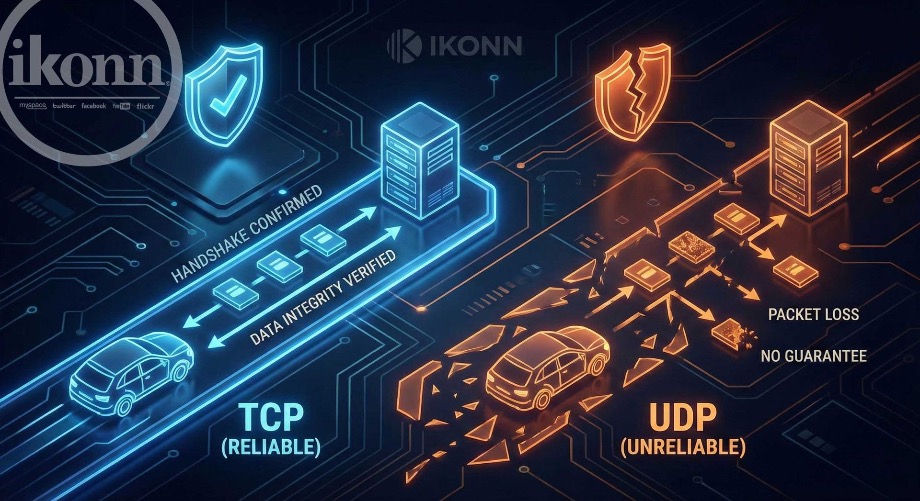
The TCP (Transmission Control Protocol) is the backbone for any operation that does not tolerate gaps in information. Unlike other methods, TCP establishes a oriented connection, meaning it performs a three-way handshake between the tracker and the server before initiating traffic. This feature ensures that each telemetry packet sent arrives at its destination intact and in the correct order. If a packet is lost in an area with unstable signal, TCP automatically manages retransmission, ensuring that the movement history remains continuous and up-to-date.
For a professional monitoring center, data integrity is non-negotiable. The use of TCP eliminates "hops" on the map caused by lost packets, providing a solid foundation for audits and claims investigations. At Ikonn, we recommend TCP as a priority choice because it reflects our pursuit of technical autonomy and absolute precision in processing critical events.
UDP: Speed at the Expense of Control
UDP (User Datagram Protocol) is known for its low latency and lower data consumption, as it does not perform delivery verification. However, this speed comes at a price: a lack of guarantee. In M2M networks, where cellular signal stability can vary drastically, UDP allows packets to be simply discarded if there is noise in the transmission. This results in a fragmented history, where vital sensor information or exact coordinates can be lost forever.
While UDP may seem attractive to massive fleets looking to reduce data traffic, the operational cost of dealing with incomplete data or a dotted trail outweighs any cent savings on CHIP. The instability generated by UDP can compromise the automation of the Rules Engine , triggering inaccurate alerts or failing to report security breaches in real time.
Why Ikonn Recommends TCP Whenever Possible
Ikonn's technical strategy is based on stability and profitability through automation. TCP is the only protocol that offers the necessary acknowledgement of receipt (ACK) to ensure the server can be certain that the mathematical truth of the field has been successfully transmitted. In critical security scenarios or complex logistics management, TCP is the foundation that allows the rules engine to operate confidently, without the risk of operating on corrupted or non-existent data.
Furthermore, TCP facilitates the management of remote commands and firmware updates (FOTA), since the data session remains open and verifiable. This robustness ensures that your control center maintains complete control over the fleet, regardless of external network conditions, raising the technical standard of your operation in the eyes of the international market.
The Impact on Consumption and Network Performance
There's a myth that TCP "consumes much more data" than UDP. While TCP overhead is slightly higher due to acknowledgment headers, the actual impact on modern M2M plans is negligible compared to the value of data integrity. Network performance with TCP is more predictable and stable, avoiding chaotic reconnection spikes that can overload the platform gateway in stateless protocols.
By choosing TCP, you are opting for superior data governance. Ikonn's infrastructure is optimized to manage thousands of simultaneous TCP connections with minimal latency, ensuring that the speed of information is not sacrificed in the name of security. It's cutting-edge engineering working to give you the perfect millisecond-by-millisecond trace of an event.
Conclusion: Stability as a Competitive Advantage
Choosing between TCP and UDP is choosing between security and uncertainty. For companies seeking leadership and operational excellence, the stability provided by TCP is the only viable path. At Ikonn, we provide the technical foundation so you don't have to worry about packet loss, ensuring your data center always operates with accurate data, complete historical records, and maximum technological efficiency.
IKONN SUPPORT: Data integrity for those who accept nothing less than perfection.
Is your control panel configured for maximum operational stability?
Consult our engineering team to migrate your protocols to TCP and ensure your fleet reports with 100% data integrity and accuracy.