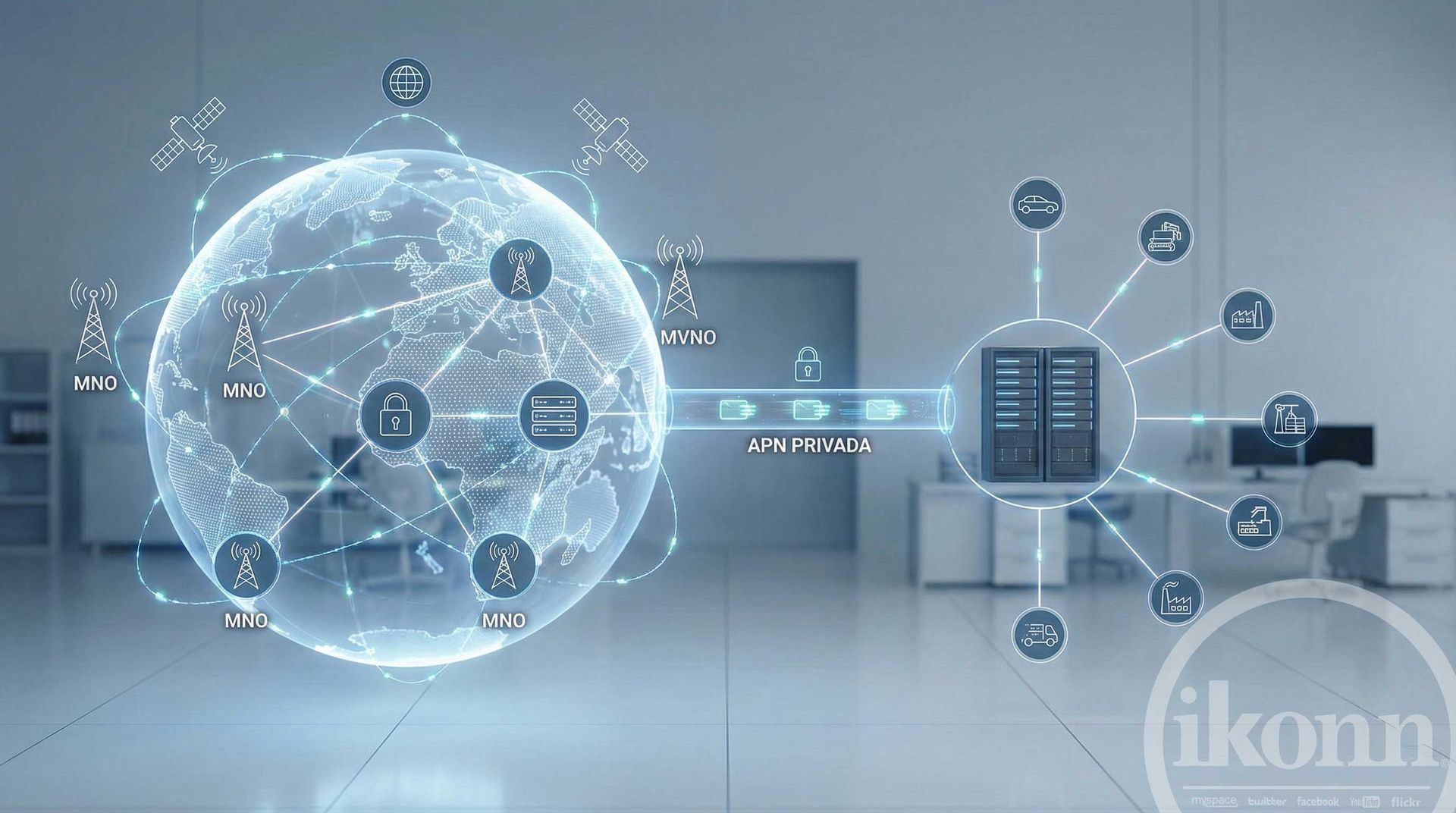
M2M Connectivity: The Science of Networks and Operators
The Nervous System of Cutting-Edge Telemetry
In the Internet of Things (IoT) and asset tracking ecosystem, connectivity is often treated as a commodity . However, for Ikonn , data transmission is a high-precision engineering discipline. The success of a tracking center depends not only on good software or robust hardware; it depends on the ability of data to traverse the telecommunications infrastructure with the lowest possible latency and highest reliability.
For entrepreneurs seeking sovereignty, understanding the inner workings of mobile operators is fundamental. There's a vast difference between the chip in your smartphone and an industrial M2M (Machine to Machine) chip. This exhaustive guide dissects the differences between traditional (MNOs) and virtual network operators (MVNOs), the critical role of APNs in data security, and the unseen challenges of international roaming. Welcome to the physical layer of elite telemetry.
1. MNO (Mobile Network Operator): The Titans of Infrastructure
MNOs , or Mobile Network Operators, are companies that own the radio frequency spectrum and the physical infrastructure of towers (BTS - Base Transceiver Stations) and network cores. In Brazil, classic examples are Vivo, Claro, and TIM.
Advantages of MNOs:
- Total Control of the Infrastructure: Because they own the towers, they have the power to prioritize traffic on their networks and perform direct maintenance at the physical layer.
- Network Capacity: They have the highest bandwidth available, which is excellent for applications that require video streaming or large volumes of data (although M2M telemetry requires small packets).
- Direct National Presence: They offer robust coverage in the areas where their towers are installed.
Disadvantages of MNOs:
- Rigid Management: Traditionally, MNOs are bureaucratic giants. For small and medium-sized tracking entrepreneurs, obtaining specialized technical support for APN or routing problems can be an exhausting journey.
- Signal Singularity: A chip from an MNO is restricted to that operator's network only. If the vehicle enters an area where Vivo has no signal, but TIM does, the tracker will enter mass memory mode, as we detail in our [reference/document/etc.]. Diagnostic and Troubleshooting Manual.
- Focus on Retail: Often, MNO support is geared towards the end consumer (B2C), neglecting the critical telemetry needs of a B2B operation.
2. MVNO (Mobile Virtual Network Operator): The Agility of Virtualization
MVNOs , or Virtual Network Operators, are companies that do not own their own radio infrastructure (BTSs), but purchase wholesale capacity from MNOs to offer specialized services. They function as an intelligence and service layer on top of the physical network.
Advantages of MVNOs:
- Multi-carrier (National Roaming): This is the "secret weapon" for telemetry. Many IoT MVNOs have agreements that allow the chip to connect to any available tower (Vivo, Claro, or TIM). If the signal from one tower drops, the hardware automatically switches to another. This drastically reduces dead zones.
- Elite Management Platforms: M2M-focused MVNOs offer sophisticated dashboards for tracking managers. You can block SIM cards, monitor KB consumption in real time, and perform connection diagnostics without needing to call a call center.
- Total Focus on IoT: They understand the nuances of binary data traffic. Their billing systems and network rules are designed for devices that send small 100-byte packets, not for YouTube users.
Disadvantages of MVNOs:
- Third-Party Dependence: If the physical infrastructure of the main operator (host) fails, the MVNO also goes down. They have little control over the physical maintenance of the towers.
- Costs by Volume: For massive operations (tens of thousands of chips), the wholesale cost of a direct MNO may be slightly lower, although the loss in agility and technical support often does not offset the savings of a few cents.
3. APN (Access Point Name): The Sovereignty Portal
The APN is the gateway address that the tracker uses to exit the cellular network and enter the internet or the private network of its control center. Essentially, it's the network identifier that allows the hardware to know where to send the bits.
Public APN vs. Private APN:
In amateur tracking, public APNs (like those of common mobile phone operators) are used. This exposes the tracker to the public internet, making it vulnerable to scanning attacks and excessive data consumption. At Ikonn , we advocate the use of private APNs .
A Private APN functions like a VPN (Virtual Private Network) over the cellular network. Data travels through an encrypted tunnel directly to the Ikonn server, without ever "touching" the open internet. This ensures... Cybersecurity and Data SovereigntyThis prevents the hardware from receiving malicious commands from external sources. Furthermore, the private APN allows for the assignment of private static IPs , facilitating the management of persistent connections between the hardware and the telemetry broker.
4. International Roaming: The Challenge of Latency and Handshake
International roaming occurs when the tracker crosses a border and needs to connect to a foreign network. While it sounds simple, there is complex engineering of handshakes and steering of roaming happening behind the scenes.
The Latency of "Home-Routing": Many M2M chips use home-routing. This means that if you have a Brazilian chip running in the US, the data leaves the tracker in Miami, travels to the network core in Brazil, and only then is sent to your server. This physical path increases the Ping (latency) , which can delay critical panic alerts or blocking.
The Danger of "Permanent Roaming": Many countries and operators have policies against permanent roaming. If a SIM card remains connected to a foreign network for more than 90 days without returning to its original network, the local operator may block the device's IMEI. This is why global exchanges are seeking eSIM (eUICC) solutions, which allow for remote switching of the operator profile (Bootstrap) to a local operator, ensuring continuity of operation without physical intervention, as we explained in [previous course/resource]. Ikonn University.
5. Conclusion: Choosing Connectivity as a Strategist
For entrepreneurs building their call center, the choice between MNO and MVNO should be based on the need for **Service Level Agreement (SLA)** and reach. If your focus is on maximum security and reduced support costs, a multi-operator MVNO with a private APN is the gold standard.
Connectivity shouldn't be a day-to-day technical concern, but rather an invisible and resilient pillar of your infrastructure. By understanding network science, you stop "waiting for the tracker to connect" and start managing a sovereign, secure, and efficient data network. At Ikonn, we look for patterns in every bit transmitted so you can focus on what really matters: the intelligence of your business.
IKONN: The technological foundation for your sovereign telemetry network.
Do you want to master the strategic management of M2M chips?
Access the advanced modules of Ikonn University and learn how to configure global connectivity infrastructures.